

002
the logic
It looks exactly like an olive.
You pick it up, put it in your mouth, and your brain sends the signal it always sends: brace for resistance. The skin. The flesh. The pit.
There is no skin. No flesh. No pit.
It dissolves. Pure olive, liquid, gone in a second.
That's not a trick. That's a world with a logic.

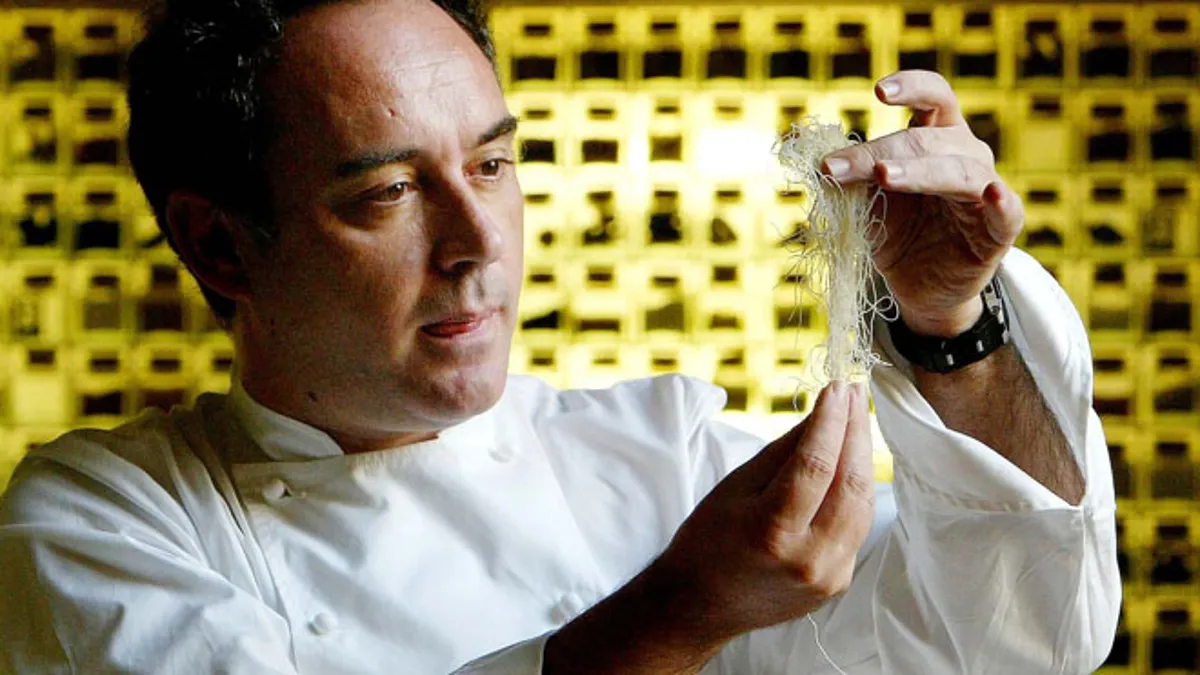
Ferran Adrià had one test for every dish at elBulli.
The dish had to break your expectation. Not just taste good. Break the gap between what you saw and what you got. A dish that was merely delicious went back to the kitchen. Not because it failed. Because it couldn't live in the world he was building.
Logic is not the same as having rules. Creators don’t build from rules, they break them or ignore them.
Logic is something different. You write the rules.
A set of internal conditions so specific to the world you’re making that certain decisions stop being choices. They become inevitable, or impossible.
Massimo Vignelli worked with four typefaces for fifty years.
He lived in a world of grids, modules, and intellectual elegance. Once a grid was established, the typeface became a tool to express that structure, not a stylistic choice to distract from it.
He famously described the proliferation of thousands of digital fonts as “one of the biggest visual pollution of all times”. Other fonts weren't "inferior", they were rejected because they were redundant within his disciplined, modernist framework.
The logic was that structure precedes style, always.

Carlo Scarpa spent ten years designing a cemetery.
During this decade, he obsessed over every single threshold. He believed that architecture was a narrative told through construction. He refused to use "filler" or "caulking" to hide how things were made.
For example, the Propylaeum (the entrance) features the famous "double circles", a threshold where two rings of blue and pink mosaic meet in a concrete wall. That transition alone took years of drafting and technical refinement to execute perfectly.
He created logic that demanded ingenuity and precision.
Three worlds. Three logics. None of them were borrowed.
Most people think restraint is something you impose on your work. A logic makes it the other way around. The work restrains itself. You author the logic.
unk